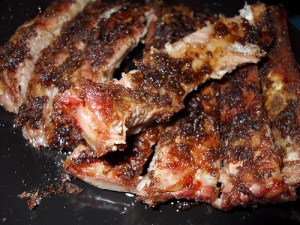
Everyone has their own way of making ribs, and some of them are pretty darn good. I enjoy my ribs tender, juicy and smoky with a hit of heat. At worst, ribs come off of the barbecue dried and stringy. When well done, however, they can be a thing of beauty.
In our house, we take our ribs very seriously. We begin the journey to perfect ribs the night before, and when rib day dawns, we plan to be home for at least five hours, carefully tending the ribs as they cook low and slow on a smoky gas grill.
If you’re in a hurry, don’t try this at home. If, however, you’re willing to wait for a good thing, then by all means give this rib grilling process a try. You’ll be very glad you did.
Step One: Choosing Your Ribs
You can use this process with either baby back or spare ribs. I prefer the baby back, which tend to be more flavorful and tender than the spare ribs. Find the meatiest racks you can – some meat cutters really skimp. Watch for bones showing through the meat. If you see them, you just may have skimpy ribs. The place with the meatiest baby backs I’ve come across? Costco. I plan for a half rack per female, a 1/4 rack per kid (except teens), and a full rack per teen or man. I usually have leftovers, but these ribs reheat well.
Step Two: Brining – The Night Before
Brining is the best thing to happen to grilled meat since the invention of barbecue sauce. It adds moisture and flavor into the meat, helping to prevent drying as you cook them. To make a brine, I add 1/2 cup of kosher salt (or 1/4 cup table salt) and 1/4 cup of Swerve sweetener per gallon of water. Find a large container or a cooler and fill with as much brine as you need to soak your ribs. Brine them for one hour the night before you plan to cook them.
Step Three: Rubbing – The Night Before
Remove ribs them from the brine, and dry them off. Then, use generous amounts of rub on both sides of the ribs. Wrap the ribs in plastic and refrigerate overnight.
Many commercial rib rubs exist. I don’t like them. They tend to be over-salty and not nearly as flavorful as a rub you make yourself. While my rib rub differs based on mood, I have a basic formula I follow using dried herbs and spices.
Two tablespoons each:
Cumin
Salt
Oregano
Chili powder
One tablespoon each:
Ground black pepper
Ground white pepper
Four tablespoons each:
Swerve sweetener
Sweet paprika
One teaspoon each:
Cayenne
You can adjust your proportions, double it, triple it – whatever you need to do. Plan on about 1/4 cup of rib rub for each rack.
Step Four: Smoke – The Night Before
If you use a regular grill, smoke preparation also begins the night before. Choose wood chips or chunks you like, and set them to soak overnight. I prefer chuks to chips for their ability to smoke longer, and applewood for its subtle flavors. You probably have a favorite. I don’t recommend hickory, which I believe is too aggressive at asserting its own flavor into the ribs.
We have a smoker, which we use to smoke our ribs. We keep it low and slow – about 275 for about four or five hours.
Step Five: Barbecue Prep – Rib Day
Congratulations! You’ve made it to rib day and you are mere hours away from the best ribs of your life. For a gas grill, set it on the lowest temperature possible, and close the lid. You want to heat it to a consistent temperature of about 275 degrees, where it should remain for most of the day. The key to ribs is low and slow. Once the grill reaches a temperature of 275 degrees, turn off one of the burners, leaving the other on low. This should allow you to keep the ribs at consistent temperature.
Make foil packets in which you place your wood chips. We like to set two or three foil packets around the grill for full saturation. Place slits in the top for the smoke to escape, and grant easy access so you can add more wood chips as needed. Place the packets underneath the grill plates and allow them to heat as you preheat your grill.
For a smoker: Turn it on to 275. Bam! You’re done.
Step Six: Cook the Ribs
If you own a smoker, this section is pretty short: smoke your ribs, low and slow, at about 250-275 until they fall off the bone (about 4-6 hours). If you own a grill, read on.
If you own rib racks, use them. This keeps the ribs from direct contact with the grill and facilitates the development of tender, fall-off-the-bone meat. You can find them at many kitchen speciality stores, and they are quite inexpensive. Otherwise, place ribs on the part of the grill where the burner has been turned off. You are going to use indirect heat to grill your ribs.
Close the lid and walk away. Every 30 minutes, check the temperature of the ribs to make sure they are still grilling low, and rotate the position of the ribs so they cook evenly. Check smoke packets to see if supplies need to be replenished, as well. Have a beer and wait.
At between 3-1/2 and 5 hours, the ribs should start to get really tender. Poke them with a fork, or give the end of a rack a small twist with tongs and see if it is falling off the bone. When it is, they’re done.
We usually stop here and eat our ribs; however, I know many people really, really, really like barbecue sauce or glaze. If you’ve carefully tended your smoke and barbecue temperature, however, these ribs will not need them. They should be smoky, sweet, and juicy.
Still, if you absolutely must, proceed to step seven.
Step Seven (Optional): Glaze the Ribs
I actually love my ribs with just the dry rub and no glaze. If you brine them and keep them on low and slow, they will be tender and moist.
If you like your ribs a little wetter, then glaze them. You could use commercial barbecue sauce, although what a waste of perfectly good ribs that would be. You could also make your own barbecue sauce, as I outlined here. However, I believe even a homemade tomato-based barbecue sauce will overwhelm the sweet smokiness of these ribs. Therefore, if your ribs must be covered in something other than deliciousness, I recommend making a glaze.
How do you make a glaze? Add:
- A base liquid (chicken stock, wine, beer, cola, or something)
- Something sweet (stevia, Swerve sweetener, honey)
- Acid (balsamic vinegar, red wine vinegar, lemon juice, etc.)
- Salt
- A dash of heat (cayenne, jalapenos, red pepper flakes, hot sauce)
Simmer it altogether on the stove until it becomes syrupy, tasting to adjust flavor. Brush the glaze on the ribs and stick them under the broiler for a few minutes to set the glaze.
 The Modern Ancestor