Sauces: Pan Sauce and Beurre Blanc

Flickr creative commons license by jeffreyw

Want to elevate your cooking? If you’re mostly a basic cook but want to find simple ways to make your cooking even better, then I’ve got a single word for you: sauce. Sauces are great ways to add flavors to your foods.

If you were all budding chefs studying cooking in depth, I’d go into detail here about the mother sauces: there are five (or six – depending on who you ask) including:

  • Velouté – A stock-based white sauce.
  • Béchamel – A flour, milk, and butter white sauce.
  • Espagnole – A rich brown sauce
  • Hollandaise/Mayonnaise – An egg yolk and fat emulsion
  • Vinaigrette – 1 part vinegar, 3 parts oil, and other herbs/spices
  • Tomato

From these sauces, many others are born. For example, if you add tarragon to hollandaise, you get béarnaise. If you add some gruyere to béchamel, you’ve got a great topping for mac n cheese or scalloped potatoes.

That’s really all I am going to say about the mother sauces today. Instead, I’m going to talk about some simple sauces you can make to add flavor to cooked meats. So, instead of having a plain steak, you could have steak with a wonderful port wine sauce. Instead of a plain piece of fish, you could have halibut topped with a delicate beurre blanc.

Pan Sauces

What we’re really talking about are pan sauces, and here’s what I like about them. Once you’ve cooked your protein in a pan, you can use the drippings in the pan to make a really fantastic pan sauce. To make a pan sauce.

  1. Remove the meat from the pan and set it aside, tented with foil. I like to cook many of my proteins in an ovenproof saute pan just so I can then use it to make a fabulous sauce.
  2. Put the pan over medium high heat on the stove top. If you’ve cooked some really fatty piece of meat, you may want to remove some of the clear fat from the pan before you do so.
  3. Add some aromatics such as shallots, onions or garlic and saute in a little oil leftover from cooking.
  4. Add an acidic liquid or alcohol to the pan such as vinegar, lemon juice, white or red wine, etc. As you add this to the pan, scrape up all of those amazingly flavored brown bits to incorporate them in the sauce.
  5. Toss in some chopped herbs. Let the sauce simmer on the stove for a bit to reduce by about 50 to 75 percent.
  6. Once the liquid has reduced, add about 1/4 to 1/2 cup of very cold unsalted butter, cut into small pieces. I add the butter a piece at a time, whisking it to emulsify. This will thicken your sauce and add richness.
  7. Taste your sauce and adjust seasoning as necessary.
  8. Serve immediately over your protein.

Beurre Blanc

This is one of my favorite sauces for seafood. I particularly like it over seared sea scallops. It has a delicate yet delicious flavor that really enhances the sweetness of the scallops.

  • 1/2 cup dry white wine
  • 1/2 cup white wine vinegar (or champagne vinegar, sherry vinegar)
  • 1 small shallot, minced
  • 3 sticks unsalted butter, cut into 1″ pieces and chilled until very cold
  • Salt and white pepper to taste
  1. Simmer shallots, wine, and vinegar in a saute pan, cooking until liquid has reduced by about 80 percent.
  2. Remove the pan from the heat momentarily, whisking two pieces of butter (one at a time) into the pan.
  3. Return the pan to low heat and continue whisking butter in a piece or two at a time until it is completely incorporated.
  4. Taste and season. Serve immediately.
  5. You can change the flavors in this by adding herbs such as basil or by adding a little citrus zest.
Coq au Vin

coqJim and I were working side-by-side in the kitchen last night. Actually, since I was in the midst of the world’s worst hot flash, he was cooking and I was instructing. Jim isn’t much of a cook – something he’ll freely admit. He can follow instructions pretty precisely and do okay. He’s awesome on the grill. He sometimes comes across something he decides is a “magic ingredient” and begins adding it to absolutely everything he cooks (such as the great Emeril Lagasse Kicked Up Gahlic Salad Dressing explosion of 2002 where he combined the salad dressing and green beans, wrapping it in a tortilla because, hey – it’s a burrito). But really what Jim does is heat stuff up so that it is warm enough to ward off bacteria and food-borne illness. This is how many people cook – with the goal of getting the food cooked, rather than making it flavorful.

On the other hand, building flavor is pretty easy if you know a few cooking techniques. If you can get food to the proper temperature in order to serve it, if you can combine ingredients in a recipe to make a dish, then you can begin to build flavors in your food. Best of all, it won’t take that much longer than just following the recipe ingredient by ingredient and your food will improve by leaps and bounds.

One of the best ways to build flavor is via the Maillard reaction. I know – it sounds all fancy, but it’s really pretty simple. When meat browns, it happens due to the Maillard reaction. When bread browns, same thing. Essentially, what you need to know about the Maillard reaction is this: it adds flavor to food. At its most basic, the Maillard reaction occurs when heat is added to foods containing amino acids and carbohydrates. In food terms, it adds tremendous savoriness meats and other foods.

For example, how do you like your steak? I am a medium rare gal, myself, but I know some people who like their steak super rare in the middle. Yet these same people wouldn’t consider eating a cut of meat that is entirely uncooked. When you are served a rare steak in a restaurant, it arrives crisp and brown on the outside, but when you cut into it, it is nearly raw. And most of the flavor on that steak comes from the brown part on the outside (as well as seasonings), which has browned due to the Maillard reaction.

To promote the Maillard reaction in your cooking:

  • Don’t crowd the pan. That inhibits the reaction and instead causes steaming. I work in batches.
  • Leave whatever you are cooking in contact with the heat without moving it for several minutes until it browns. Do this with vegetables, mushrooms, onions, meats. This allows for tremendous flavor development.
  • If you are thickening with flour, add it to the heated fat in the pan and then let it cook for a few minutes to develop flavor.
  • When you add liquids to a pain that you’ve browned meat and/or vegetables in to make a sauce, don’t waste the flavor that is stuck to the pan. Use the side of a wooden spoon to scrape the browned bits off the bottom of the pan.

Let’s look at the application of the Maillard Reaction in a recipe for coq au vin.

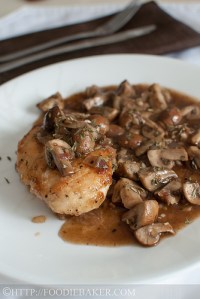
Coq au Vin

  • 6 thick slices bacon, chopped
  • One chicken, cut into pieces, skin left on
  • Salt and black pepper to taste
  • 1 lb button mushrooms, quartered
  • 1-1/2 cup pearl onions (fresh or frozen)
  • One onion, diced
  • One carrot, peeled and diced
  • One celery stalk, peeled and diced
  • 4 cloves garlic, sliced
  • 6 tbsp flour (or sweet rice flour for gluten-free)
  • Two cups dry red wine
  • Two cups gluten-free chicken stock
  • 2 Tbsp thyme
  1. Preheat oven to 350 degrees.
  2. In a large, oven proof pot such as a dutch oven, cook bacon over medium high heat until crisp. Remove bacon from fat with a slotted spoon and set aside.
  3. Season chicken pieces with salt and pepper. Working in batches, cook the chicken pieces in the bacon fat until skin is browned on both sides.
  4. Remove chicken from pan and set aside. Add the mushrooms to the oil in the pan. Allow them to stay in contact with the pan for about four minutes to brown before stirring them. Continue to stir and cook for a few more minutes. Remove from oil with a slotted spoon and set aside.
  5. Add pearl onions to the pan, allowing them to stay in contact with the pan and brown for a few minutes before stirring. Once cooked, remove them from the pan and set aside.
  6. Add mirepoix to pan (diced onions, carrots, celery). Cook in the oil without stirring until they are browned. Once browned, stir and cook until tender.
  7. Add garlic and continue to cook, stirring until garlic releases its scent – about 30 seconds.
  8. Sprinkle the flour over the vegetables and stir to cook flour about four minutes.
  9. Pour wine into pan, scraping the bottom of the pan and stirring as you do. Cook for a few minutes to remove alcohol flavors.
  10. Add chicken stock and thyme. Stir to combine.
  11. Return chicken, mushrooms, pearl onions, and bacon to the pan, making sure you add any juices that have accumulated, as well. Stir to combine and bring to a simmer.
  12. Cover pan and place in preheated oven. Cook 60 minutes, until chicken is tender. Serve with egg noodles or rice if you prefer gluten-free.

Chicken Soup with Homemade Noodles – Love in a Bowl

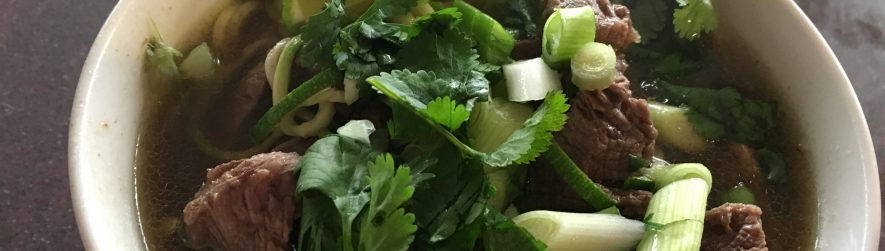
chickensoupFor me, cooking for my family and friends is about more than just the Zen I achieve in the kitchen. It’s also about putting love on a plate. Food that is made with love has a certain extra something that you don’t get when you open a can or microwave a meal. I spend time considering ingredients, deciding how to build flavors, and planning which foods will complement one another on a plate. I try to create foods that the people I am cooking for will love. I put my heart and soul into my food, and hopefully it comes across in the way I intended it – as a plate or bowl full of pure love.

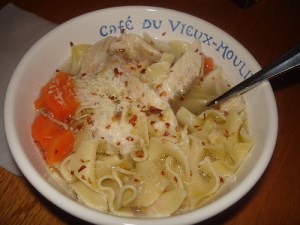
Today, I made a simple dish, but for me it is the epitome of love in a bowl: chicken soup. This simple meal can be tremendously satisfying when you take the time to develop flavors. Making it even more satisfying, I made some basic egg noodle dough and rough cut noodles that floated in the soup. As sometimes happens, fate stepped in and I had a bunch of ingredients in my refrigerator that lent itself well to chicken soup – and that I needed to get rid of. The result was delicious, and the thickly cut egg noodles made it hearty and satisfying, as well.

Homemade Egg Noodles

  • 1-1/2 cup of flour
  • 1/2 tsp salt
  • 2 large eggs
  1. Sift the flour and salt into a bowl. Make a well in the center of the flour, and crack the eggs into it.
  2. I mix the noodles with my (very clean) hands, gradually incorporating the flour into the eggs until I have a rough dough.
  3. Turn the dough out onto a floured surface and knead it until it is smooth and elastic, about 5 minutes.
  4. Allow the dough to sit for 10 minutes to relax the glutens.
  5. If using a pasta roller, roll to desired width and roughly cut into egg noodles.
  6. If using a rolling pin, roll the dough to desired thickness and cut into strips.
  7. Set aside for a few hours to dry slightly.

Chicken Soup with Egg Noodles

  • 1 pound boneless, skinless chicken – I prefer thighs for flavor and texture
  • Salt and fresh cracked black pepper to taste
  • Lite (in color – not calories) olive oil
  • 1 carrot, peeled and diced
  • 1 stalk celery, diced
  • 1 onion, diced
  • 1 bulb fennel, diced
  • 5 cloves of garlic, minced
  • Chicken stock
  • 1/2 lb crimini mushrooms, chopped
  • Thyme
  • Juice of one or two lemons
  • Salt and black pepper to taste
  1. Cut chicken into bite sized chunks. Season with salt and pepper.
  2. Heat a few swirls of lite olive oil in a large pot over medium high heat until it shimmers.
  3. Working in batches, cook chicken in the pot. Don’t overcrowd the pan. Allow the chicken full contact with the pot bottom until  it starts to brown. As the meat browns, it caramelizes the sugars in the protein, known as the Maillard reaction. Once the meat has caramelized on one side, turn it over to allow it to continue to cook through. Your chicken will not react with caramelization if the pan is too crowded, so work in two or three batches.
  4. Remove the cooked chicken from the pot with a slotted spoon and set it aside on a plate.
  5. Add the carrots, celery, onion, and fennel to remaining oil in the pot, distributing evenly across the bottom. Allow vegetables to stay in contact with the pot without stirring until it begins to brown (but not burn), about 4-5 minutes. This allows the flavors to caramelize and will add richness to your soup.
  6. Stir in garlic, cooking just until the garlic is fragrant. If you cook it for more than about 30 seconds, the garlic can burn and become bitter.
  7. Add chicken stock to fill pot about half way, scraping the bottom of the pan as you do to lift all of the flavors that have caramelized there.
  8. Add mushrooms, lemon juice and a few teaspoons of thyme.
  9. Return chicken to the pan, pouring any juices that have collected on the plate into the soup, as well.
  10. Bring soup to a boil, and add the noodles.
  11. Return to a boil and cook until noodles are el dente – about 6 to 7 minutes.
  12. Taste and season as needed with salt and pepper.

That’s the chicken soup I made today, but mine is never the same twice. I just used what I had available in my refrigerator. The good thing about chicken soup is that you can change it to suit your own tastes. Change the thyme for rosemary. Add different seasonal vegetables like zucchini or green beans. Add rice instead of egg noodles. Once you can make a basic chicken soup, the possibilities are endless to make your own love in a bowl.

Baking Bread

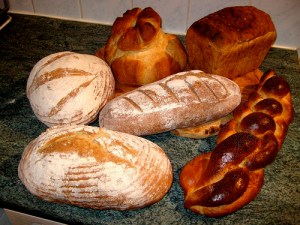
breadYeast breads have a reputation for being notoriously difficult, because they take the better part of a day to create. However, I adore baking yeast breads. There is something very zen about kneading the dough until it changes under your hands, becoming smooth and elastic. Every year, I bake my family a big batch of cinnamon rolls with cream cheese frosting that are absolutely delicious. I use potatoes and flour to make a sponge for the yeast, which leaves the dough very moist and delicious. I also like to make rolls, pizza crust, focaccia, and all kinds of other breads. Today, I’ve got rosemary and sea salt bread rising on my counter top as I type this. But I digress…

Basic Bread Dough Proportions

Baking bread is not nearly as difficult as it sounds if you’ve got the time to spare.

  • A basic bread yeast dough contains (by weight) 5 parts flour to 3 parts water, plus salt, yeast, and other ingredients you may wish to add.
  • If you want to make a loaf of bread out of three cups of flour (each cup is about 4 oz), then you will need about  7 0z of water or some other liquid.
  • I like to use about 5 oz of water and 2 oz of milk just to add richness to the dough.
  • To that, add about a teaspoon of yeast and toss in a little salt (1/4-1/2 teaspoon).

Bread Baking Technique

When making your bread, use the following techniques.

  1. Sprinkle the yeast over a few ounces of your water. Use water that is about 110 degrees, and allow it to sit until bubbles form. I often toss a little sugar or honey in this mixture just to feed the yeast a little more.
  2. Whisk together your flour and salt. Then, add the water with the yeast, as well as your remaining liquid ingredients. Stir until it forms into a loose ball.
  3. Turn the ball out onto a floured surface. You will spend the next ten minutes or so kneading the dough, which develops the glutens and makes the dough much more elastic. To knead, fold the dough over, press together with the heels of your hands, turn the dough 1/4 turn, and repeat. Continue this process, and the dough will become smooth, soft and elastic.
  4. It is virtually impossible to overknead if you are hand kneading. If you are using a mixer to knead, you can overknead. How do you know when the dough is ready? Here are several tests.
  5. Press your hand firmly on the top of the dough and hold for 30 seconds. If the dough is even remotely sticky under your hand when you remove it, you need to keep kneading.
  6. Poke the dough deeply with your finger. If the divot springs back into place, the dough is ready. If the divot remains, keep kneading.
  7. Take a small piece of the dough and gently stretch. If you can stretch it thin enough to see light shining through the dough before it breaks, it’s ready. If you can’t – keep kneading.
  8. Place the kneaded dough into an oiled bowl. Cover it with a damp towel and set aside to rise. Typically, you can allow it to rise about two hours until it doubles in size. If you use less yeast, it may take longer to rise. If you use more or rapid rise yeast, it will take longer to rise.
  9. While many people prefer the convenience of rapid rising, the slower you allow your dough to rise, the more flavor it develops. If you want a really flavorful bread, use less yeast and let it rise for several hours until it doubles in size.
  10. After rising, punch the dough down.
  11. Knead briefly again and let sit for about 20 minutes.
  12. Shape dough into your baking shape and allow it to rise again, for about 60 minutes.
  13. Preheat your oven to 450 degrees.
  14. Score the top of your loaf with a knife, and brush top with olive oil. Sprinkle with a little salt.
  15. Bake at 450 for 10 minutes. Reduce the heat to 375, and bake for 45 to 50 minutes more.

Variations

That’s your basic bread baking technique. So what can you vary? Shape. Size. Ingredients. Add some olive oil, butter, or sugar. Turn it into pizza dough – it’s up to you! Today, I’ve got a bread dough rising with chopped rosemary in it, and I will sprinkle it with coarse sea salt before I bake it. Other things you can add:

  • Roasted garlic
  • Cheeses
  • Oregano
  • Chopped rosemary
  • Thyme
  • Jalapenos
  • Honey
  • Brown sugar
  • Molasses
  • Different types of flour
  • Sesame seeds
  • Caraway
  • Poppy seeds

Some great combinations to try:

  • Roasted garlic rosemary
  • Cheddar jalapeno
  • Caramelized onions and thyme
  • Oregano and Asiago cheese

You are only limited by your imagination, once you know how to bake a basic lean bread dough.

Braising Methods

potroastI’m a huge fan of braising. This simple cooking technique makes a great winter meal because it favors hearty foods naturally available in the winter like root vegetables and warmer, richer flavors. It’s also a great way to cook a tough or less expensive piece of meat.

The braising technique relies on cooking over low heat (usually either on the stovetop or in the oven – although sometimes in a crockpot) in a sealed container with moisture. Braising works really well for tough cuts of beef such as stew meat, chuck roast, game meats, or pot roast.

When you braise, you break down the collagen in the meat and the fat melts through it, making it more tender and flavorful. While many people think braises are stringy, they don’t have to be. Coq au Vin is a braise, as is Osso Bucco, and Boeuf Bourguignon. If you use enough moisture and select the right cut of meat, your braise will be fork tender and not at all stringy.

Here’s what I really like about braising:  it allows you to develop flavors, and if you know how to do it you can create any number of dishes simply and easily.

Ready to create a braise? The steps are simple.

  1. Select your meat. Don’t use an expensive, naturally tender cut like a rib-eye or filet mignon. This method does not work well for those meats. Instead, choose something that is less tender and, frankly, cheaper. I like chuck roast, bottom round, and brisket. You can choose similar cuts of pork, as well.
  2. Select your aromatics and herbs. What flavors would you like in your braise? I recommend starting out with a basic mirepoix – a dice of one carrot, one celery stalk and one half onion. To that you can add just about any herb. Some of my favorites with beef are garlic, thyme, rosemary or tarragon.
  3. Select any vegetables you might like. Beyond the basic mirepoix, would you like carrot chunks, parsnips, tomatoes, mushrooms, or others? Root vegetables work well in braises.
  4. Select your braising liquid. I usually use about half chicken stock and half wine or beer. Other add ins to braising liquid may include citrus or other juices (I once braised a pork roast in pomegranate and orange juices with chicken stock and some cayenne. It was fantastic!), or a hard liquor such as whiskey or rum (use sparingly.) You can also use something acidic, such as vinegar, but balance it with stock.

Once you have your basic flavors, make your braise.

  1. Season your meat with salt and pepper.
  2. In a large pot, use some kind of fat (I’m a fan of cooking a little bacon to toss into the braise for flavor and searing the meat in the bacon fat) to sear the meat on all sides. Leave the meat in contact with the pan to caramelize it for several minutes on each side before moving it.
  3. Remove the meat from the pot and set it aside.
  4. Using the same oil, add your aromatics (except garlic). Allow them contact with the hot pan for several minutes without stirring in order to caramelize and add more flavor. Stir and brown aromatics. If you are adding garlic, toss it in for the last 30 seconds in this step, just until it releases its scent.
  5. For more flavor, add a tablespoon of tomato paste if you want and allow it to brown with the aromatics. This will deepen the flavor without giving it a tomato taste.
  6. Leave the aromatics in the pot and add a few tablespoons of flour. The flour will thicken your final product. Stir the flour with the oil until it is a tan color. This will remove the raw flour flavor and add an additional depth to your dish.
  7. Add your alcoholic beverage (or vinegar) to the pot, using your wooden spoon to scrape up all of the brown bits (called fond) on the bottom of the pot.
  8. Add the stock and stir to combine. Total liquid should go about half way up a roast.
  9. Return the meat to the pot and add any vegetables and herbs.
  10. Bring the pan to a simmer, and cover tightly.
  11. Either leave the tightly covered pot on the stovetop over low heat or in a 300-350 oven. Braising time will vary depending on the cut of meat you are cooking. For chicken, it may take just an hour. For small cuts of beef chopped up, it takes around two to 2-1/2 hours. For a full roast, it may take as long as six hours. Look at a recipe for something similar to your braise to estimate a cooking time and temperature.
  12. When the meat is cooked, remove the lid and turn up flame on the stove. Remove the meat and simmer liquids to reduce. Taste for seasoning and adjust.
  13. Serve with a starchy side covered in your braising liquids. Good sides include rice, polenta, mashed potatoes, spätzle, and herbed egg noodles.

Easy, right? Here are a few combination suggestions.

  • Beef short ribs and bacon with red onions and thyme, braised in Guinness Stout and chicken stock. Serve with smashed red potatoes.
  • Chunks of beef roast with bacon, mushrooms and pearl onions, braised in red wine and chicken stock. I like thyme to season this one. Serve with egg noodles or spätzle.
  • Whole chicken pieces with bacon and pearl onions, braised in white wine and chicken stock with tarragon. Serve with rice or egg noodles.
  • Pot roast and root vegetables seasoned with rosemary and garlic, and braised in beef stock and red wine.
  • Veal shanks braised with mirepoix, sliced carrots, garlic, and chopped tomatoes in white wine, juice of an orange, and chicken stock (osso bucco). Season after cooking by stirring in a chopped combination of parsley, garlic, and lemon/orange zest  (gremolata). Serve with egg noodles.

Homemade Butterscotch Pudding

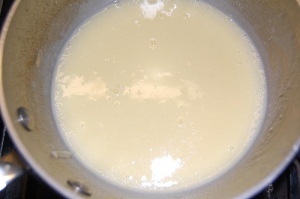
puddingWhen is the last time you had homemade pudding? Many people have never had it. I’m not talking about the kind of pudding that came as a powder in a box that you had to either cook or beat for a couple of minutes. I’m talking honest-to-goodness pudding from scratch.

Like many others, I hadn’t bothered making pudding in any way other than from a box since my high school Home Ec. Then, one day about eight years ago, I was eating some watery, tasteless butterscotch pudding from a cup, and I thought, “How hard can it be to make pudding with some flavor and texture?”

It was easy! And fast! In total, that first batch of butterscotch pudding took me about five minutes, but what a difference five minutes made. The pudding was rich, creamy, and complexly flavored. Over the years I’ve tweaked my recipe and gotten it to the perfect blend of butterscotch, salt, and a hint of vanilla. If you’ve got five minutes and you’d like to get in the wayback machine to see how real butterscotch pudding used to taste, try it. It’s pretty foolproof, and well worth the effort.


  • 3 T dark brown sugar
  • 3 T unsalted butter
  • 1/2 cup heavy cream
  • pinch salt
  • 2 cups whole milk (not 2 percent or skim)
  • 3 T corn starch
  • 3 T water
  • 1 tsp. vanilla

Method

  1. In a saucepan, melt butter and blend in brown sugar until well combined and bubbly.
  2. Stir in heavy cream until sugar/butter is dissolved.
  3. Remove from heat.
  4. Add salt and whole milk, stirring to combine.
  5. Allow to cool to lukewarm. Meanwhile, combine water and cornstarch to form a slurry.
  6. Return pudding to medium heat and slowly add the slurry, stirring constantly.
  7. Continue to stir until pudding begins to thicken and bubble around the edges.
  8. Reduce heat to medium and continue to cook, stirring for one minute.
  9. Remove from heat and stir in vanilla.
  10. Spoon pudding into custard cups and chill.

Christmas Cookies for the Baking Impaired

cookiesDo you love Christmas cookies? Are you baking impaired? I’ve got good news. These are the world’s easiest Christmas cookies, requiring very little work with an incredibly impressive result. I’ve even given these as gifts, and people believe I’ve spent hours in the kitchen baking them.

A confection of sugar cookies sandwiched together and filled with a sweet almond filling and then dipped in creamy milk chocolate, these cookies are rich and really gorgeous. And did I mention easy? Best, you can vary the simple recipe, changing the filling for raspberry or other flavors, changing the coating to white chocolate or butterscotch…you can be as creative as you’d like.

Recipe and instructions below, and I promise – simple.

You will need:

  • 1-2 rolls of refrigerated sugar slice and bake sugar cookie dough
  • 1-2 cans of almond filling (not almond paste – you can find this in the baking aisle of the grocery store)
  • 1-2 packages of almond bark (large chunks of chocolate coating in cubes you can find in the baking aisle at Christmas time)
  • Almonds for garnish
  • Parchment paper

Technique:

  1. Bake sugar cookies as described on package and cool fully.
  2. Spread a thin layer of almond filling between two cookies.
  3. Melt almond bark according to package directions. Dip cookie sandwiches in almond bark, coating completely. Set on parchment to cool.
  4. While the chocolate is still soft, garnish cookie with an almond or almond slice.

That’s it. Easy, huh?

Tips for Better Pie Crust

crustI believe the reason so many avoid baking pies is this: pie crust can be a pain in the behind. It’s hard to make it pretty and flaky – and sometimes the two seem mutually exclusive. In fact, if I have to opt for one of the other, I’m always going with flaky over pretty. I’d rather have an ugly pie that tastes good than one that looks gorgeous but has a crust like shoe leather.

The reason these two goals often seem mutually exclusive is this: the more you work with pie crust dough, the tougher it gets. Working the dough binds the glutens, resulting in a tougher pastry. Most pastries are the exact opposite of breads. With bread, you want to work the dough as much as possible to toughen up the gluten and bind it together. That’s why you knead bread dough. With pies, you want to create little bits of fat within loosely bound flour. That way, when the fat melts during the baking process, it leaves air pockets that produce flakes.

You can really use any pie dough recipe – I use Cook’s Illustrated’s recipes. What is important is that you follow a few procedures to make the dough just as flaky as possible.

  1. Handle the dough minimally. Roll it only once. Don’t re-roll it, or you will toughen it up. Likewise, only stir enough to bring the dough together. To do this, I combine butter and dry ingredients in the food processor, pulsing a few times to create a sandy mixture. Then, I pour that mixture in a small bowl and sprinkle water over the top – just enough to bring the mixture together. I lightly mix it with a rubber spatula until it forms a loose, shaggy ball, adding more water only if I need it. Your dough should not appear homogenous – just together.
  2. Use very cold butter, and cut it into 1/2″ cubes. The colder the butter, the better because this allows it to stay in small clumps within the dough that will melt away and leave flakes.
  3. Use ice water. This keeps the butter from melting before you bake the pie.
  4. Before you roll the dough, wrap it in plastic and refrigerate it for about 30 minutes. If you are making a two crust pie, wrap two balls separately. This facilitates ease of rolling. When you remove it from the refrigerator, let it sit for a few minutes to soften slightly.
  5. Roll the dough out on a very well-floured surface and use a well-floured rolling pin. I use either a Silpat or my Corian countertops, which I meticulously dry before rolling out the dough. I am also a fan of the French style rolling pin because I feel it gives me more control as I roll out my pie crust.
  6. If your crust breaks apart, rather than re-rolling it, patch it together. In my opinion, better an ugly pie than a tough one! You can always “fix” your ugliness by cutting decorations out of the remaining crust and putting it over the ugliest spots. I do it all the time.
  7. Don’t forget to cut slits in the top crust to allow steam to escape.
  8. Re-refrigerate your crust for about 30 min before baking.

Looking for an even more foolproof crust? Try Cook’s Illustrated’s crust that uses vodka for an even flakier pastry!

Tips for Perfect Mashed Potatoes

mashedHere are my tips for the perfect potatoes.

1. Select flavorful potatoes to start. I really like Yukon Gold potatoes. I also like russets, which make delicious mashed potatoes.

2. Boil the potatoes in their skins. This keeps the part of the potato you will be using from becoming water logged. Once the potatoes are boiled, remove the skins.

3. Whatever you do, don’t beat the potatoes. Using any kind of a mechanical beater will remove lumps, but it also binds the starches in potatoes and makes them gluier. Instead, I use a potato ricer. Put manageable chunks of the peeled hot potatoes through the ricer into a bowl.

4. Don’t use milk or cream. It creates gloppy potatoes. Instead, melt some unsalted butter (using unsalted allows you to control the amount of salt in your dish) and pour it over riced potatoes. Give the potatoes a quick mix with a wooden spoon or rubber spatula. This keeps the taters fluffy because the fat from the butter coats the starches, keeping it light.

5. Before you serve, taste the potatoes for seasoning and add sea salt and fresh cracked black pepper a little at a time until you get the right seasoning. You need some salt, because salt enhances flavors, but you probably don’t need nearly as much as you think. That’s why I suggest adding a little at a time, tasting, and adjusting as you go.

Roasted Poultry Stock

stockHow to Make Roasted Poultry Stock

  1. Preheat your oven to 450.
  2. Arrange about four pounds of turkey and chicken wings in a roasting pan in a single layer, and roast for one hour.
  3. Remove the poultry from the pan and add one cup of water to the pan, scraping to remove all of the flavorful browned bits from the bottom.
  4. In a large stockpot, saute two ribs of celery, two carrots, and two onions roughly chopped in a few tablespoons of oil until tender. Add poultry, water from roasting pan, and about one gallon of water to the pot and bring to a simmer.
  5. Meanwhile, wrap 1/2 teaspoon of peppercorns, several sprigs of parsley, several sage leaves, two bay leaves, and several sprigs of fresh thyme in cheesecloth and tie with kitchen twine. Drop it in the simmering water.
  6. Simmer, uncovered, for three hours. Allow to cool and strain out solids. Store in the refrigerator in a tightly sealed container.

You can use homemade stock in gravy, soups, sauces, and stews. It has much better flavor than canned broths.