Roasted Root Veggies

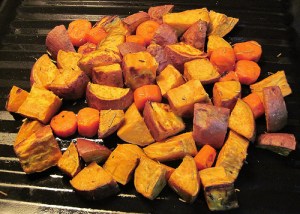
sweetpotatoesThese aren’t your traditional sweet, sticky potatoes. Instead, they are a simple roast of julienned potatoes that bring out the slightly sweet, nutty flavor of the potatoes.

  • 1-2 sweet potatoes, peeled and julienned.
  • 2-4 Yukon gold potatoes, peeled and julienned
  • 3 tablespoons olive oil
  • 2-4 shallots, thinly sliced
  • 3 tablespoons chopped, fresh thyme
  • 2-4 tablespoons minced red onion
  • 1 clove garlic, put through garlic press
  • 1 tablespoon butter, melted (eliminate for dairy-free)
  • Salt and fresh cracked black pepper to taste
  1. Heat oven to 400 degrees.
  2. In a large roasting pan, toss potatoes and sweet potatoes with olive oil, shallots, thyme, and onion.
  3. Spread in a thin layer across the bottom of the pan.
  4. Roast for 20 minutes until brown.
  5. Remove from onion and toss with butter, garlic, salt, and pepper.

Orange Ginger Cranberry Sauce

  • cranberries1 bag fresh cranberries
  • Juice of two oranges
  • 1/4 cup water
  • Zest of one orange
  • 2 tablespoons fresh grated ginger
  • 1 cup sugar (or use stevia or honey for paleo)
  • Fresh grated cinnamon to taste.
  1. Place berries in a non-reactive saucepan.
  2. Add orange juice, water, sugar, ginger, and orange zest.
  3. Boil until cranberries begin to pop.
  4. Reduce heat to simmer and cook until cranberries release their pectin and sauce is desired consistency.
  5. Add cinnamon to taste.
  6. Refrigerate overnight before serving.

Hazelnuss Kranz (Hazelnut Ring)

hazelnutThis past week, a friend of mine posted a picture of Haselnuss-Kranz on her Facebook page and it looked delicious. It’s a German dessert made of a sweet shortcrust rolled around a sweetened hazelnut filling and rolled into a ring. Living as close to Oregon as we do, we’re huge hazelnut fans, so I sought to find the recipe. What I found is that it is so German, English language recipes are difficult to find. Finally, I found a recipe by Nigella Lawson, which I began to fiddle with. Nigella’s recipe is written in grams – easy with a kitchen scale but a little more difficult if you you don’t have one. I used my kitchen scale for exact measurements, but I’ve converted here for your ease (and Americanized the recipe slightly).


German Hazelnut Ring

Crust

  • 2 cups flour
  • 2 tsp baking powder
  • 3/4 cups sugar
  • 1 tbsp. vanilla
  • 1 egg
  • 2 tbsp. milk
  • 1 stick butter, very cold and cut into cubes

Filling

  • 1-1/2 cups hazelnuts, finely ground
  • 1/2 tsp. almond extract
  • 4 tbsp. evaporated milk
  • 3/4 cup sugar
  • 1 egg white

Glaze

  • 1 egg yolk
  • 1 tbsp. evaporated milk
  1. Preheat the oven to 350 degrees.
  2. Sift flour, sugar, and baking powder into the bowl of a food processor.
  3. Add butter and liquids, sprinkling evenly over the top of the ingredients.
  4. Pulse the food processor for 10 one-second pulses until mixture resembles wet sand
  5. Pour mixture onto a clean surface (I use a Silpat) and pull it together in a ball, kneading a few times to make sure mixture is smooth.
  6. Refrigerate the dough wrapped in plastic for 20 minutes.
  7. Meanwhile, grind hazelnuts finely in the food processor with ten one second pulses.
  8. Pour hazelnuts in a bowl with remaining filling ingredients and mix well.
  9. Roll short crust into a rectangular shape that is about 11″ x 15″.
  10. Spread filling over pastry and roll the pastry length-wise.
  11. Shape pastry into a ring and place on a parchment paper lined cookie sheet.
  12. Mix together glaze and spread over top of ring.
  13. Using a knife, score the pastry with X or star shapes in several spots.
  14. Bake for 45 minutes until golden brown.

Christmas Cookies for the Baking Impaired

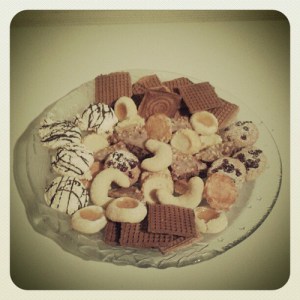
cookiesDo you love Christmas cookies? Are you baking impaired? I’ve got good news. These are the world’s easiest Christmas cookies, requiring very little work with an incredibly impressive result. I’ve even given these as gifts, and people believe I’ve spent hours in the kitchen baking them.

A confection of sugar cookies sandwiched together and filled with a sweet almond filling and then dipped in creamy milk chocolate, these cookies are rich and really gorgeous. And did I mention easy? Best, you can vary the simple recipe, changing the filling for raspberry or other flavors, changing the coating to white chocolate or butterscotch…you can be as creative as you’d like.

Recipe and instructions below, and I promise – simple.

You will need:

  • 1-2 rolls of refrigerated sugar slice and bake sugar cookie dough
  • 1-2 cans of almond filling (not almond paste – you can find this in the baking aisle of the grocery store)
  • 1-2 packages of almond bark (large chunks of chocolate coating in cubes you can find in the baking aisle at Christmas time)
  • Almonds for garnish
  • Parchment paper

Technique:

  1. Bake sugar cookies as described on package and cool fully.
  2. Spread a thin layer of almond filling between two cookies.
  3. Melt almond bark according to package directions. Dip cookie sandwiches in almond bark, coating completely. Set on parchment to cool.
  4. While the chocolate is still soft, garnish cookie with an almond or almond slice.

That’s it. Easy, huh?

Tips for Better Pie Crust

crustI believe the reason so many avoid baking pies is this: pie crust can be a pain in the behind. It’s hard to make it pretty and flaky – and sometimes the two seem mutually exclusive. In fact, if I have to opt for one of the other, I’m always going with flaky over pretty. I’d rather have an ugly pie that tastes good than one that looks gorgeous but has a crust like shoe leather.

The reason these two goals often seem mutually exclusive is this: the more you work with pie crust dough, the tougher it gets. Working the dough binds the glutens, resulting in a tougher pastry. Most pastries are the exact opposite of breads. With bread, you want to work the dough as much as possible to toughen up the gluten and bind it together. That’s why you knead bread dough. With pies, you want to create little bits of fat within loosely bound flour. That way, when the fat melts during the baking process, it leaves air pockets that produce flakes.

You can really use any pie dough recipe – I use Cook’s Illustrated’s recipes. What is important is that you follow a few procedures to make the dough just as flaky as possible.

  1. Handle the dough minimally. Roll it only once. Don’t re-roll it, or you will toughen it up. Likewise, only stir enough to bring the dough together. To do this, I combine butter and dry ingredients in the food processor, pulsing a few times to create a sandy mixture. Then, I pour that mixture in a small bowl and sprinkle water over the top – just enough to bring the mixture together. I lightly mix it with a rubber spatula until it forms a loose, shaggy ball, adding more water only if I need it. Your dough should not appear homogenous – just together.
  2. Use very cold butter, and cut it into 1/2″ cubes. The colder the butter, the better because this allows it to stay in small clumps within the dough that will melt away and leave flakes.
  3. Use ice water. This keeps the butter from melting before you bake the pie.
  4. Before you roll the dough, wrap it in plastic and refrigerate it for about 30 minutes. If you are making a two crust pie, wrap two balls separately. This facilitates ease of rolling. When you remove it from the refrigerator, let it sit for a few minutes to soften slightly.
  5. Roll the dough out on a very well-floured surface and use a well-floured rolling pin. I use either a Silpat or my Corian countertops, which I meticulously dry before rolling out the dough. I am also a fan of the French style rolling pin because I feel it gives me more control as I roll out my pie crust.
  6. If your crust breaks apart, rather than re-rolling it, patch it together. In my opinion, better an ugly pie than a tough one! You can always “fix” your ugliness by cutting decorations out of the remaining crust and putting it over the ugliest spots. I do it all the time.
  7. Don’t forget to cut slits in the top crust to allow steam to escape.
  8. Re-refrigerate your crust for about 30 min before baking.

Looking for an even more foolproof crust? Try Cook’s Illustrated’s crust that uses vodka for an even flakier pastry!

Tips for Perfect Mashed Potatoes

mashedHere are my tips for the perfect potatoes.

1. Select flavorful potatoes to start. I really like Yukon Gold potatoes. I also like russets, which make delicious mashed potatoes.

2. Boil the potatoes in their skins. This keeps the part of the potato you will be using from becoming water logged. Once the potatoes are boiled, remove the skins.

3. Whatever you do, don’t beat the potatoes. Using any kind of a mechanical beater will remove lumps, but it also binds the starches in potatoes and makes them gluier. Instead, I use a potato ricer. Put manageable chunks of the peeled hot potatoes through the ricer into a bowl.

4. Don’t use milk or cream. It creates gloppy potatoes. Instead, melt some unsalted butter (using unsalted allows you to control the amount of salt in your dish) and pour it over riced potatoes. Give the potatoes a quick mix with a wooden spoon or rubber spatula. This keeps the taters fluffy because the fat from the butter coats the starches, keeping it light.

5. Before you serve, taste the potatoes for seasoning and add sea salt and fresh cracked black pepper a little at a time until you get the right seasoning. You need some salt, because salt enhances flavors, but you probably don’t need nearly as much as you think. That’s why I suggest adding a little at a time, tasting, and adjusting as you go.

Roasted Poultry Stock

stockHow to Make Roasted Poultry Stock

  1. Preheat your oven to 450.
  2. Arrange about four pounds of turkey and chicken wings in a roasting pan in a single layer, and roast for one hour.
  3. Remove the poultry from the pan and add one cup of water to the pan, scraping to remove all of the flavorful browned bits from the bottom.
  4. In a large stockpot, saute two ribs of celery, two carrots, and two onions roughly chopped in a few tablespoons of oil until tender. Add poultry, water from roasting pan, and about one gallon of water to the pot and bring to a simmer.
  5. Meanwhile, wrap 1/2 teaspoon of peppercorns, several sprigs of parsley, several sage leaves, two bay leaves, and several sprigs of fresh thyme in cheesecloth and tie with kitchen twine. Drop it in the simmering water.
  6. Simmer, uncovered, for three hours. Allow to cool and strain out solids. Store in the refrigerator in a tightly sealed container.

You can use homemade stock in gravy, soups, sauces, and stews. It has much better flavor than canned broths.

Lamb Recipes

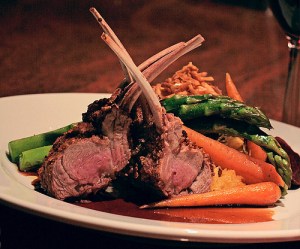
rackoflambMany people shy away from cooking lamb for an array of reasons. Some people don’t like it. Others think it is “fancy” food, and it’s true, certain cuts of lamb can be expensive. Some just may not have a clue how to cook it.

I am a big fan of lamb, especially of the pasture-raised, local, grass-fed variety. The meat is tender and flavorful, providing a nice break from routine. The good news is cooking lamb is no more difficult than preparing any other meat.

Some find lamb gamey in flavor. The best way to remedy this is to trim away the fat before you eat it (but not before you cook it – the fat is essential in cooking lamb), and to provide some vinegar, garlic, or herbs as a counterpoint to cut through the flavor. The gaminess also depends on the cut you choose. Lamb chops and leg of lamb tend to be a bit gamier, which is why so many people pair them with mint sauce. Rack of lamb or rib cuts, on the other hand, are tender and delicious without a hint of game.

Today, I will offer you two ways to prepare lamb. Both are simple and delicious. The “fancy” preparation I save for special occasions – though it is shockingly easy to prepare. The other I will often serve for regular meals.

Leg of Lamb with Roasted Garlic and Shallots

Ingredients

  • 1/2 cup red wine vinegar
  • 1/2 cup white wine vinegar
  • 2 tablespoons chopped fresh rosemary
  • 2 tablespoons dry oregano
  • 3 cloves garlic, pressed through a press
  • Three bulbs garlic (or more)
  • Six shallots (or more)
  • Drizzle olive oil
  • One leg of lamb, butterflied with bone removed
  • Kosher salt and fresh cracked pepper to taste
  • Chopped, fresh rosemary

Method

  1. Pour vinegar, olive oil, rosemary, and oregano into a bowl and whisk. Marinate lamb in this for 4-6 hours.
  2. Preheat the oven to 350 degrees.
  3. Slice the tops off of the heads of garlic and halve the shallots. Place them in a baking dish, cut side up and drizzle with olive oil.
  4. Cover with foil and roast for 90 minutes, until garlic and shallots are soft.
  5. Raise oven temperature to 500 degrees.
  6. Squeeze garlic and shallots out of the dried skins into a bowl and mash together.
  7. Lay lamb out on the counter and season with salt and fresh cracked pepper.
  8. Spread garlic and shallot mixture over surface of butterflied lamb.
  9. Sprinkle with chopped rosemary.
  10. Roll lamb into a roast and tie with butcher’s twine.
  11. Season outside of lamb with salt and pepper.
  12. Place in roasting pan and put in oven for 10 minutes to sear lamb.
  13. Reduce heat to 325 degrees and cook until lamb reaches an internal temperature of 130 degrees, about an hour (or longer for larger cuts. Check temperature regularly).
  14. Allow to rest 20 minutes before carving and serving.

Herb Crusted Rack of Lamb

Ingredients

  • One stick of grass-fed butter, softened
  • 6 cloves of garlic, minced
  • 1/2 cup almond meal
  • 1/4 cup chopped fresh parsley
  • 1/4 cup chopped fresh thyme
  • One rack of lamb, Frenched
  • Kosher salt and fresh cracked black pepper, to taste

Method

  1. Preheat your oven to 425 degrees.
  2. Combine butter, garlic, almond meal, parsley, and thyme to form a loose paste.
  3. Score the fat on the rack of lamb crosswise, avoiding cutting all the way through to the meat.
  4. Season rack of lamb with salt and pepper.
  5. Press bread crumb mixture onto fleshy side of the rack of lamb, covering the meat entirely but leaving bones exposed.
  6. Place in a roasting pain, crust side up.
  7. Roast for about 30 minutes, until a meat thermometer in the thickest part of the lamb reads 135 degrees.
  8. Allow to rest 20 minutes before cutting and serving.

Serve with an earthy Pinot Noir or French Burgundy (made from Pinot Noir), which is a classic food/wine pairing. Favorites include Martinelli Pinot Noir from California or a Domaine Serene Pinot Noir from Oregon.